
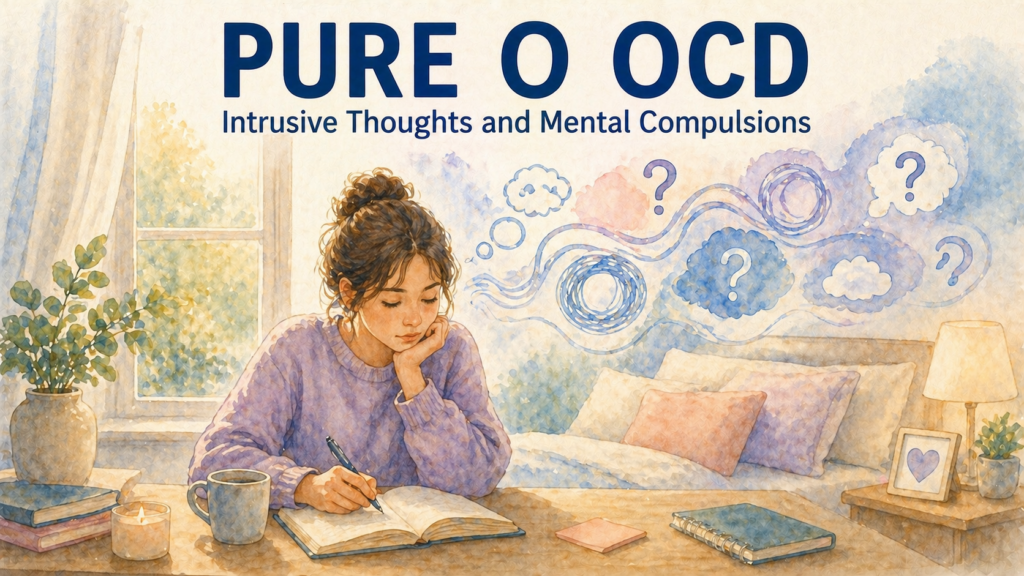
Pure O OCD is a phrase people use when OCD symptoms are mostly internal. The person may have intrusive thoughts, images, doubts, or urges, but few visible rituals.
The name can be misleading. "Pure O" sounds like obsessions without compulsions. In many cases, compulsions are still present – they are just mental or hidden.
This article is educational and not a diagnosis. If intrusive thoughts or mental rituals are causing distress, a licensed mental health professional can help assess what is happening.
What is Pure O OCD?
Pure O is commonly used to describe OCD where compulsions are not easy to see from the outside. A person may appear calm while spending hours inside their mind reviewing, analyzing, neutralizing, or trying to get certainty.
Common themes may include:
- Harm thoughts
- Sexual or taboo intrusive thoughts
- Religious or moral fears
- Relationship doubts
- Existential questions
- Health fears
- Fear of being a bad person
- Fear that a thought means something important
The theme may vary, but the cycle is familiar: intrusive thought, distress, mental compulsion, brief relief, and the thought returning.
Common mental compulsions
| Mental compulsion | What it may look like |
|---|---|
| Rumination | Going over the same question for hours |
| Mental review | Replaying memories to check what happened |
| Thought neutralizing | Replacing a bad thought with a good one |
| Testing feelings | Checking whether you feel anxious, attracted, guilty, or certain |
| Self-reassurance | Telling yourself the same answer repeatedly |
| Confession urges | Feeling driven to disclose every thought |
| Researching | Searching online to prove what the thought means |
| Comparing | Measuring yourself against others or past versions of yourself |
Mental compulsions may feel automatic. Learning to notice them is often the first step.
Pure O vs. intrusive thoughts
Intrusive thoughts alone are not the same as OCD. Many people experience unwanted thoughts from time to time. In Pure O, the thought becomes sticky because of the meaning attached to it and the effort to solve it.
| Intrusive thought experience | Pure O-like loop |
|---|---|
| A thought appears and passes | A thought appears and feels urgent |
| The person may feel briefly unsettled | The person analyzes what it means |
| No repeated ritual follows | Mental checking or reassurance follows |
| Life continues | The thought begins to take up time and attention |
The issue is not the thought itself. The issue is the repetitive attempt to get certainty or relief.
Why Pure O can be hard to recognize
Pure O can be easy to miss because there may be no obvious washing, checking, or arranging. Friends and family may not see the effort happening inside.
The person may also feel ashamed of the content of the thoughts. Because the thoughts can involve taboo, moral, violent, religious, or relationship themes, people may fear being judged if they tell anyone.
That shame can delay support. A clinician who understands OCD can help respond to these thoughts without shock or judgment.
How rumination becomes a ritual
Rumination can feel like problem-solving, but in Pure O it often becomes circular. The person may return to the same question again and again, hoping one more analysis will finally make the doubt disappear.
Examples include:
- "What did that thought mean?"
- "Did I feel the right emotion?"
- "Would a good person think this?"
- "What if I am lying to myself?"
- "How can I know for sure?"
The goal of treatment is not to find the perfect answer to every doubt. It is to practice stepping out of the argument and returning to life while uncertainty is still present.
What helps with Pure O OCD?
OCD treatment often includes CBT with exposure and response prevention (ERP). For Pure O, response prevention may mean reducing mental rituals rather than stopping a visible behavior.
Examples may include:
- Not answering the intrusive question
- Allowing uncertainty to remain
- Reducing mental review
- Not replacing a thought with a "safe" thought
- Returning attention to the present task
- Resisting the urge to research or confess for relief
- Practicing values-based action even while doubt is present
ERP for internal symptoms can be subtle, so professional guidance may be especially useful.
The Pure O OCD test can help users reflect on symptoms, while the OCD exercises page offers daily practice support.
What not to do
Some responses can accidentally strengthen the cycle:
- Arguing with every thought
- Searching for perfect certainty
- Asking for reassurance repeatedly
- Testing whether you "really" believe or feel something
- Avoiding all triggers
- Treating every thought as meaningful
The goal is not to force thoughts away. The goal is to change how you respond when they appear.
When to seek professional support
Support may be helpful if intrusive thoughts or mental compulsions:
- Take up significant time
- Cause shame, fear, or distress
- Interfere with relationships, work, school, sleep, or faith life
- Lead to avoidance
- Make you feel trapped in your own mind
- Include immediate safety concerns
If there is immediate risk of harm, seek urgent help right away.
FAQ
Is Pure O really OCD?
Pure O is a common informal term. It often describes OCD with mostly mental compulsions rather than visible rituals.
Can Pure O have compulsions?
Yes. Mental compulsions such as rumination, review, reassurance, and neutralizing are common.
Can I take a Pure O test?
You can use a screening tool like the Pure O OCD test for reflection, but it cannot diagnose you.
Not sure what those questions are getting at? See the seven signs a Pure O OCD test actually measures.
Does having taboo thoughts mean I want them?
Not necessarily. Intrusive thoughts can be unwanted and distressing. A professional can help assess symptoms in context.