
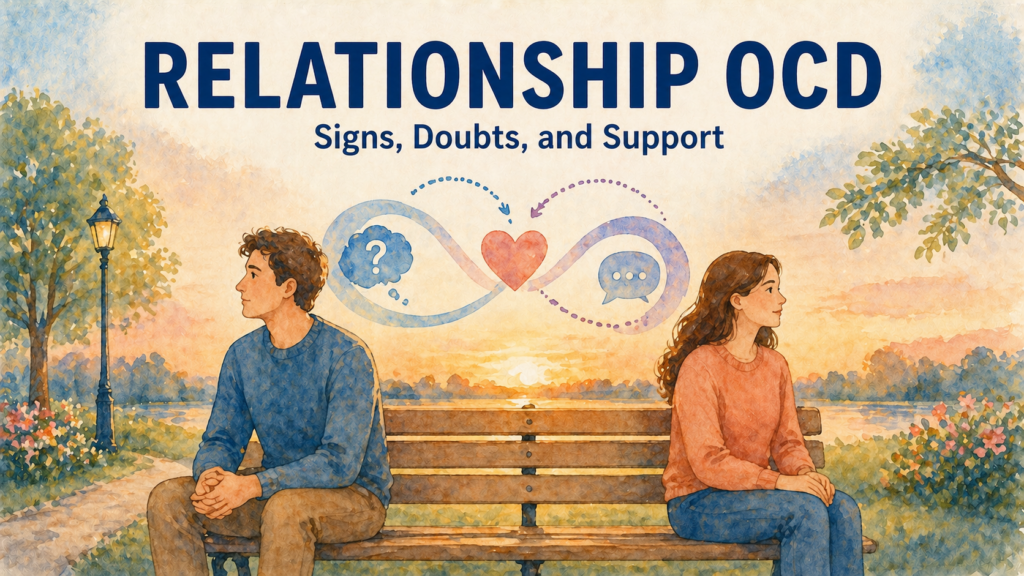
Relationship OCD, often called ROCD, is a pattern where obsessive doubt attaches itself to a relationship. The person may care deeply about their partner, but still feel trapped in questions like "Do I really love them?", "Are they right for me?", or "What if I am making a mistake?"
These questions can feel urgent and painful. The person may spend hours checking their feelings, comparing their relationship, searching online, replaying conversations, or asking for reassurance.
This article is educational and not a diagnosis. Relationship doubts can happen for many reasons, including ordinary stress, incompatibility, anxiety, trauma, depression, or OCD. If the pattern is repetitive, distressing, and hard to interrupt, it may be worth speaking with a licensed mental health professional.
What is relationship OCD?
Relationship OCD is not a separate diagnosis in every clinical manual. It is commonly used to describe OCD symptoms that focus on relationship themes.
The core pattern is still OCD:
- An intrusive doubt appears
- Anxiety rises
- The person tries to get certainty or relief
- The relief does not last
- The doubt returns stronger
In ROCD, the obsession may focus on the relationship itself, the partner, attraction, compatibility, love, commitment, or the "rightness" of the relationship.
Common ROCD doubts
ROCD can sound convincing because relationships naturally matter. The content of the doubt may feel important, but the loop is the key signal.
| ROCD doubt | Possible compulsion |
|---|---|
| "Do I really love my partner?" | Checking feelings repeatedly |
| "What if I am with the wrong person?" | Comparing the partner to others |
| "What if I am not attracted enough?" | Testing attraction or scanning for flaws |
| "What if this feeling means I should leave?" | Searching online for signs |
| "What if I am leading them on?" | Confessing, asking reassurance, or mentally reviewing |
| "What if someone else would be better?" | Comparing imagined futures |
The goal of the compulsion is often certainty. But certainty rarely stays. The mind asks for another check, another answer, another review.
ROCD vs. normal relationship concerns
It is normal to have questions in a relationship. Healthy reflection can help people communicate, set boundaries, and make thoughtful decisions. ROCD is different because the process becomes repetitive and fear-driven.
| Healthy relationship reflection | ROCD-like loop |
|---|---|
| Leads to clearer communication | Leads to more checking and doubt |
| Allows uncertainty | Demands certainty right now |
| Considers real behavior and values | Searches for perfect internal feelings |
| Happens in proportion | Takes up hours or repeats daily |
| Helps a decision | Makes decisions feel impossible |
This does not mean every doubt is OCD. Real relationship problems should be taken seriously. But when the main issue is the need to feel perfectly certain, OCD may be part of the pattern.
Common compulsions in relationship OCD
ROCD compulsions can be visible or internal. They may include:
- Asking friends if the relationship seems right
- Googling "relationship anxiety vs. ROCD"
- Checking whether you feel love at the right intensity
- Comparing your partner to exes, strangers, or idealized partners
- Mentally reviewing conversations
- Testing attraction
- Avoiding romantic moments because they trigger checking
- Confessing every doubt to relieve guilt
- Seeking signs from social media, dreams, or body sensations
These behaviors may reduce anxiety for a short time, but they often train the brain to treat uncertainty as dangerous.
Why ROCD can feel so convincing
ROCD often targets what matters most. If you value honesty, it may say you are deceiving your partner. If you value commitment, it may say you are making the wrong choice. If you value love, it may demand that love should feel perfectly clear all the time.
The presence of doubt does not automatically mean the relationship is wrong. It also does not automatically mean the relationship is right. The healthier goal is to respond to doubt with less compulsive checking, so decisions can be made from values and reality rather than panic.
What helps with ROCD?
Treatment for OCD often includes cognitive behavioral therapy (CBT), especially exposure and response prevention (ERP). For ROCD, ERP may involve allowing relationship uncertainty to be present while reducing checking, reassurance seeking, and mental review.
Examples of support may include:
- Learning the OCD cycle
- Naming compulsions without judging yourself
- Practicing uncertainty tolerance
- Reducing reassurance rituals gradually
- Making values-based choices instead of fear-based choices
- Working with a therapist who understands OCD and relationship themes
The ROCD case studies page can also help users understand how relationship-focused OCD has been studied, while the assessments page offers self-check tools for reflection.
How partners can respond
Partners often want to help by giving reassurance. This is understandable. But repeated reassurance can accidentally keep the cycle alive.
Supportive responses may sound like:
- "I care about you, and I do not want to feed the checking loop."
- "I can sit with you while the anxiety passes."
- "Let us talk about real relationship needs, not answer the same OCD question again."
- "This sounds like a good thing to bring to your therapist."
The goal is not to be cold. The goal is to support the person without becoming part of the ritual.
FAQ
Is relationship OCD the same as relationship anxiety?
Not always. Relationship anxiety can have many causes. ROCD usually involves obsessive doubt and compulsions such as checking, reassurance seeking, or mental review.
Does ROCD mean I should stay in my relationship?
No article can answer that. ROCD work is about reducing compulsive fear loops so real decisions can be made more clearly.
Can ROCD affect good relationships?
Yes. OCD can attach itself to valued relationships. The presence of intrusive doubt does not automatically mean the relationship is unhealthy.
What if there are real problems in the relationship?
Real problems matter. A therapist can help separate values-based concerns from OCD-driven checking and urgency.