
Obsessive-compulsive disorder (OCD) can feel exhausting. A person may know a fear is unlikely, but still feel pulled into checking, washing, reassurance-seeking, mental review, avoidance, or other rituals.
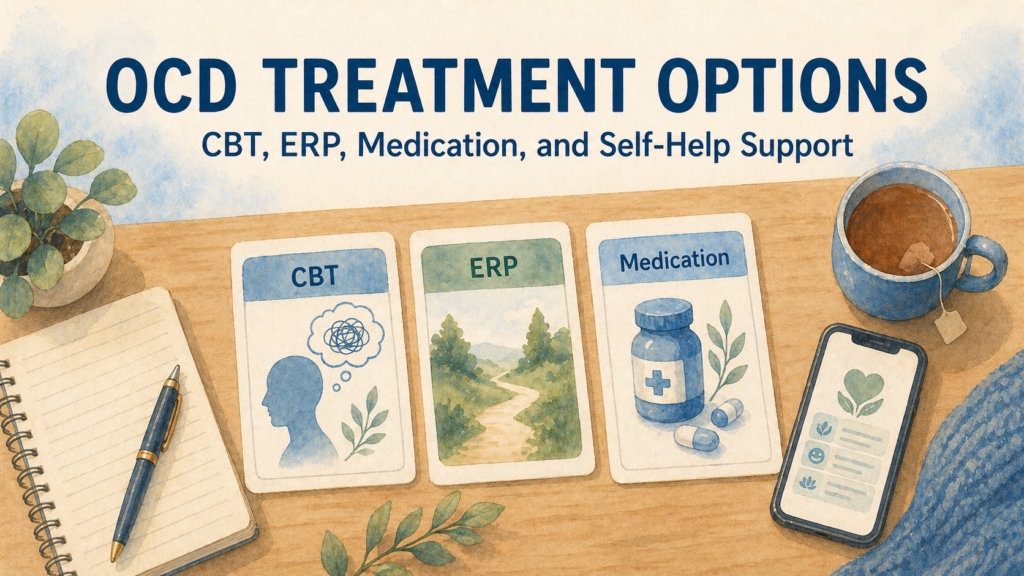
The good news is that OCD is a well-studied condition, and there are evidence-based ways to reduce its impact. The most commonly recommended supports include cognitive behavioral therapy (CBT), exposure and response prevention (ERP), medication, and structured self-help tools.
This guide explains the main options in plain English. It is educational only and does not replace advice from a licensed mental health professional.
Quick comparison of OCD support options
| Option | What it is | Best for | Notes |
|---|---|---|---|
| CBT | A structured therapy that works with thoughts, behaviors, and responses | Understanding OCD patterns and building new skills | Often includes ERP for OCD |
| ERP | A specific CBT approach that gradually faces triggers while reducing rituals | OCD obsessions and compulsions | Strong evidence base for OCD |
| Medication | Usually prescribed by a medical professional, often SSRIs | Moderate to severe symptoms or when therapy alone is not enough | Requires professional monitoring |
| Self-help tools | Books, exercises, apps, tracking, psychoeducation | Daily practice and maintenance | Best when evidence-informed and realistic |
| Combined care | Therapy plus medication and daily tools | Complex, severe, or long-standing symptoms | Often personalized by a clinician |
CBT for OCD
Cognitive behavioral therapy is a structured form of therapy that looks at how thoughts, feelings, behaviors, and physical sensations interact.
For OCD, CBT is not simply "think positive." It usually focuses on how a person responds to intrusive thoughts, uncertainty, and anxiety.
A CBT-based plan may help someone:
- Identify their OCD cycle
- Notice compulsions and avoidance
- Understand how reassurance and checking keep the loop going
- Practice different responses to uncertainty
- Build tolerance for discomfort without rituals
CBT is often most helpful when it includes ERP, which is one of the most researched therapy methods for OCD.
ERP therapy for OCD
Exposure and response prevention, often called ERP, is a specific type of CBT used for OCD.
The "exposure" part means gradually facing a feared thought, situation, feeling, image, or uncertainty. The "response prevention" part means practicing not doing the usual compulsion.
For example:
- Someone with checking fears may practice leaving after checking once.
- Someone with contamination fears may gradually touch everyday objects without repeated washing.
- Someone with relationship OCD doubts may practice noticing uncertainty without seeking reassurance.
- Someone with intrusive harm thoughts may practice allowing the thought to be present without mental review.
ERP is not meant to be reckless or overwhelming. It is usually planned step by step with a trained clinician. The aim is to learn, through experience, that anxiety can rise and fall without rituals.
Medication for OCD
Medication can be part of OCD care for some people. Selective serotonin reuptake inhibitors, often called SSRIs, are commonly discussed in clinical guidance for OCD. A prescriber may also consider other options depending on the person, medical history, symptom severity, side effects, and response.
Medication decisions should always be made with a qualified medical professional. Do not start, stop, or change medication based on an article or app.
This area moves fast — newer options like ketamine and memantine are being studied as add-ons, with mixed results so far. Our September 2026 research roundup covers what the latest trials actually found.
Medication may be considered when:
- Symptoms are moderate to severe
- OCD is interfering with daily functioning
- Therapy is not enough by itself
- Depression, anxiety, or other concerns are also present
- A clinician recommends combined care
Self-help support for OCD
Self-help can be useful, but it needs to be realistic. OCD is not usually helped by endless reassurance, thought suppression, or trying to solve every doubt.
Helpful self-help tools often focus on:
- Psychoeducation: learning how the OCD cycle works
- Tracking triggers and compulsions
- Practicing small response-prevention steps
- Building routines that support sleep, stress reduction, and consistency
- Learning to tolerate uncertainty
- Reinforcing therapy skills between sessions
An app can support daily practice, especially when it is based on CBT principles. It should not claim to diagnose, replace therapy, or cure OCD.
What does a good OCD care plan usually include?
Every person is different, but a thoughtful plan often includes:
| Care plan element | Why it matters |
|---|---|
| Clear assessment | Helps separate OCD from other concerns and identify severity |
| Psychoeducation | Makes symptoms less confusing and reduces shame |
| ERP or CBT-based practice | Targets the cycle that keeps OCD going |
| Relapse-prevention plan | Helps maintain progress after symptoms improve |
| Family or partner education | Reduces accommodation and reassurance loops |
| Measurement | Tracks whether symptoms and functioning are improving |
| Crisis plan when needed | Supports safety if risk is present |
What to avoid
Some responses can feel helpful at first but strengthen the OCD loop over time.
| Common trap | Why it can backfire |
|---|---|
| Reassurance-seeking | Relief fades and the doubt returns |
| Repeated checking | Teaches the brain that checking was necessary |
| Avoidance | Keeps the feared situation feeling dangerous |
| Mental reviewing | Turns uncertainty into a long internal debate |
| Thought suppression | Makes the thought feel more important |
| Over-researching symptoms | Can become another compulsion |
How ocd.app can fit into support
ocd.app can be positioned as a CBT-based self-help support tool for daily practice. It may help users build consistency, learn exercises, and stay engaged with small steps over time.
Important wording: ocd.app should be framed as support, not as a replacement for professional diagnosis, therapy, or medical care.
When to speak with a professional
Consider professional support if OCD symptoms:
- Take up significant time each day
- Cause distress or shame
- Interfere with work, school, relationships, sleep, or daily routines
- Involve intense avoidance
- Feel difficult to resist
- Are connected with depression, panic, substance use, or safety concerns
If you are worried about immediate safety, contact emergency services or a crisis line in your area.
Infographic prompt
Use this prompt to create an infographic for the article:
FAQ
What is the most common therapy for OCD?
CBT with ERP is one of the best-supported psychological approaches for OCD. A trained clinician can help decide whether it is appropriate for a specific person.
Can OCD be managed without medication?
Some people benefit from therapy and skills practice without medication. Others benefit from medication, therapy, or both. This is a personal medical decision best made with a qualified professional.
Is self-help enough for OCD?
Self-help can support learning and daily practice, especially for mild symptoms or maintenance. If symptoms are distressing, impairing, or risky, professional support is important.
Can ocd.app replace therapy?
No. ocd.app can support daily practice and education, but it should not replace diagnosis, therapy, or medical advice from a licensed professional.