
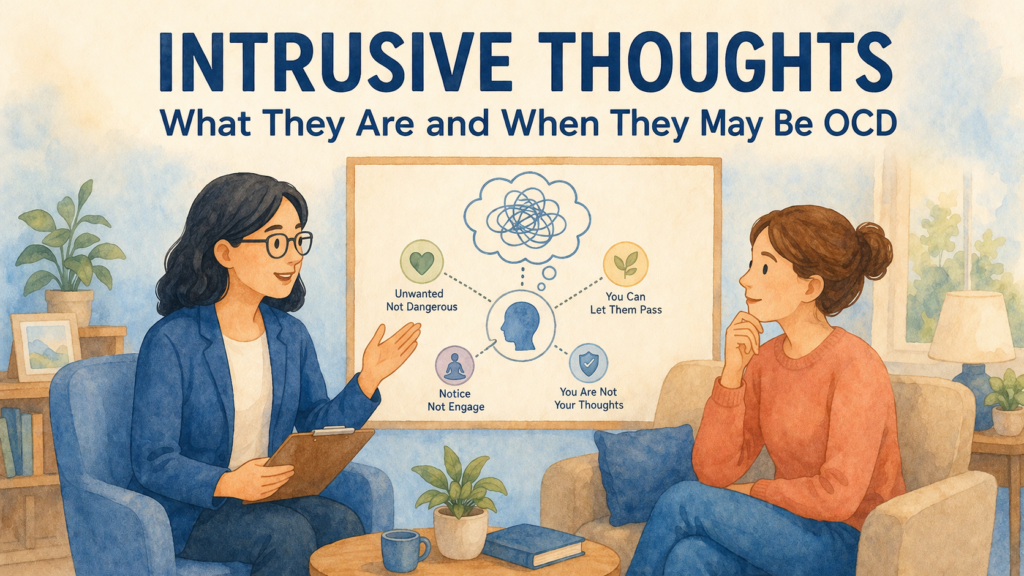
Intrusive thoughts are unwanted thoughts, images, or urges that seem to pop into your mind without permission. They can feel strange, upsetting, or completely out of character.
For many people, intrusive thoughts pass quickly. A person might think, "What if I said something awful?" or "What if I left the stove on?" and then move on. But for some people, the thought gets stuck. It feels urgent, meaningful, or dangerous, even when they do not want it and do not agree with it.
With harm-themed thoughts, the sticking point is usually a second question: "what if I act on it?" We look at whether people with OCD act on intrusive thoughts in a dedicated article.
That sticky loop is where intrusive thoughts can overlap with obsessive-compulsive disorder (OCD).
This article is educational and not a diagnosis. If intrusive thoughts are causing distress, taking up a lot of time, or affecting daily life, it may help to speak with a licensed mental health professional.
What are intrusive thoughts?
Intrusive thoughts are unwanted mental events. They may appear as:
- Words or phrases
- Images
- Doubts
- Urges
- "What if" scenarios
- Memories or mental replay
- Sudden fears about harm, mistakes, health, relationships, morality, or safety
Having an intrusive thought does not mean you want the thought to happen. It also does not mean the thought reflects your values or character.
In OCD, the problem is often not the first thought. The problem is the cycle that follows: fear, checking, reassurance, avoidance, rumination, or mental reviewing.
Are intrusive thoughts normal?
Yes, intrusive thoughts are common. Many people experience unwanted thoughts from time to time. They can happen when you are tired, stressed, anxious, overwhelmed, or simply going about your day.
The key difference is how the mind responds to the thought.
| Intrusive thought pattern | More typical response | OCD-like response |
|---|---|---|
| A strange thought appears | "That was odd," then it passes | "Why did I think that? What does it mean?" |
| A doubt shows up | Briefly checks once or moves on | Checks repeatedly or mentally reviews |
| A fear feels uncomfortable | Accepts uncertainty | Needs certainty before feeling safe |
| The thought conflicts with values | Recognizes it as unwanted | Treats the thought as a threat or warning |
| Anxiety rises | Comes down naturally | Compulsions bring short relief, then the fear returns |
This does not mean every sticky thought is OCD. But if the pattern becomes repetitive, distressing, and hard to interrupt, it is worth paying attention to.
When might intrusive thoughts be related to OCD?
OCD usually involves obsessions and compulsions.
Obsessions are unwanted thoughts, images, urges, or doubts that cause distress. Compulsions are behaviors or mental actions a person feels driven to do to reduce the distress or prevent something bad from happening.
Intrusive thoughts may be more OCD-like when they:
- Keep returning even when you try to dismiss them
- Feel urgent or threatening
- Make you seek certainty, reassurance, or proof
- Lead to repeated checking, washing, confessing, researching, or avoidance
- Cause you to mentally review events for long periods
- Make everyday activities harder
- Take up more than an hour a day
- Feel difficult to resist, even when part of you knows the fear may be excessive
OCD can attach itself to many themes. The theme is not the most important part. The loop is.
Common intrusive thought themes
Intrusive thoughts can involve almost any topic. Some common themes include:
| Theme | What the intrusive thought may sound like |
|---|---|
| Contamination | "What if I touched something unsafe?" |
| Checking | "What if I left the door unlocked?" |
| Harm | "What if I hurt someone, even though I do not want to?" |
| Relationship doubts | "What if I do not really love my partner?" |
| Moral or religious fear | "What if I did something unforgivable?" |
| Health anxiety | "What if this body sensation means something serious?" |
| Symmetry or order | "What if it feels wrong until I fix it?" |
| Identity or meaning | "What if this thought says something about who I am?" |
These examples are not diagnostic labels. They are patterns people may recognize. A clinician can help determine what is actually going on.
Why trying to suppress intrusive thoughts can backfire
It is natural to want an upsetting thought to disappear. But trying to force a thought away can make it feel more important.
For example, if you tell yourself, "Do not think about this," your brain may keep checking whether the thought is still there. That checking can pull the thought back into focus.
This is one reason OCD can feel so frustrating. The more a person tries to prove the thought is meaningless, the more attention the thought receives.
The OCD intrusive thought cycle
The cycle often looks like this:
- An unwanted thought or doubt appears.
- Anxiety or discomfort rises.
- The person tries to feel certain or safe.
- They do a compulsion, such as checking, reassurance-seeking, mental review, avoidance, or researching.
- Anxiety drops for a short time.
- The brain learns that the compulsion was necessary.
- The thought returns stronger or more often.
The goal is not to never have intrusive thoughts. The goal is to change the response so the thought has less power over your day.
What can help with intrusive thoughts?
Different people need different kinds of support. For OCD-related intrusive thoughts, the best-supported psychological approach is cognitive behavioral therapy (CBT), especially exposure and response prevention (ERP).
ERP is usually done with a trained clinician. It helps a person gradually face feared thoughts, feelings, or situations while reducing compulsive responses. Over time, the brain can learn that uncertainty and discomfort can be handled without rituals.
Self-help tools may also support daily practice, especially when they encourage consistent, gentle skill-building. They should not replace professional care when symptoms are severe, risky, or impairing.
Infographic prompt
Use this prompt to create an infographic for the article:
Helpful ways to respond in the moment
These are not a substitute for therapy, but they can be a useful starting point:
- Name the experience: "This is an intrusive thought."
- Avoid debating with the thought for too long.
- Notice the urge to check, review, confess, or seek reassurance.
- Practice allowing uncertainty instead of solving the thought.
- Bring attention back to what you were doing.
- Be kind to yourself. A thought is not the same as an action, intention, or identity.
When to seek support
Consider speaking with a mental health professional if intrusive thoughts:
- Cause intense distress
- Lead to repeated rituals or avoidance
- Interfere with work, school, relationships, sleep, or daily tasks
- Make you feel unsafe
- Feel impossible to manage alone
If you are in immediate danger or might harm yourself or someone else, seek emergency help right away through local emergency services or a crisis hotline.
FAQ
Are intrusive thoughts a sign that I want something bad to happen?
Not necessarily. Intrusive thoughts are unwanted by definition. In OCD, a thought often feels disturbing because it conflicts with what the person values.
Can intrusive thoughts go away completely?
Some people experience fewer intrusive thoughts over time. For many, the bigger change is that the thoughts feel less threatening and take up less space.
Is reassurance helpful?
Reassurance can feel helpful in the moment, but in OCD it may become part of the cycle. The relief is often temporary, and the doubt returns.
Can an app help with intrusive thoughts?
An app may support daily CBT-based practice, reflection, and skill-building. It should be used as support, not as a replacement for diagnosis or care from a licensed professional when symptoms are significant.
[{“@context”:”https://schema.org”,”@type”:”Article”,”headline”:”Intrusive Thoughts: What They Are and When They May Be OCD”,”description”:”Intrusive thoughts are unwanted thoughts, images, or urges. Learn when they may be part of OCD and what can help you respond more calmly.”,”mainEntityOfPage”:”https://ocd.app/intrusive-thoughts/”,”publisher”:{“@type”:”Organization”,”name”:”ocd.app”,”url”:”https://ocd.app”}},{“@context”:”https://schema.org”,”@type”:”FAQPage”,”mainEntity”:[{“@type”:”Question”,”name”:”Are intrusive thoughts a sign that I want something bad to happen?”,”acceptedAnswer”:{“@type”:”Answer”,”text”:”Not necessarily. Intrusive thoughts are unwanted by definition. In OCD, a thought often feels disturbing because it conflicts with what the person values.”}},{“@type”:”Question”,”name”:”Can intrusive thoughts go away completely?”,”acceptedAnswer”:{“@type”:”Answer”,”text”:”Some people experience fewer intrusive thoughts over time. For many, the bigger change is that the thoughts feel less threatening and take up less space.”}},{“@type”:”Question”,”name”:”Is reassurance helpful?”,”acceptedAnswer”:{“@type”:”Answer”,”text”:”Reassurance can feel helpful in the moment, but in OCD it may become part of the cycle. The relief is often temporary, and the doubt returns.”}},{“@type”:”Question”,”name”:”Can an app help with intrusive thoughts?”,”acceptedAnswer”:{“@type”:”Answer”,”text”:”An app may support daily CBT-based practice, reflection, and skill-building. It should be used as support, not as a replacement for diagnosis or care from a licensed professional when symptoms are significant.”}}]}]