
body.postid-2591 .sgl-featured{height:auto!important;aspect-ratio:16/9!important;overflow:hidden!important;background:#f7f1e6}
body.postid-2591 .sgl-featured img.wp-post-image{width:100%!important;height:100%!important;max-height:none!important;aspect-ratio:16/9!important;object-fit:contain!important;object-position:center center!important;display:block!important;contain-intrinsic-size:798px 448px!important;background:#f7f1e6}
People often search for OCD subtypes because they want to understand why their symptoms look different from someone else’s. One person may wash repeatedly. Another may check locks. Another may feel trapped in relationship doubts or unwanted harm thoughts.
If you want to see which themes fit your own experience, the free OCD subtypes test takes three minutes and points you to the detailed test for each theme.
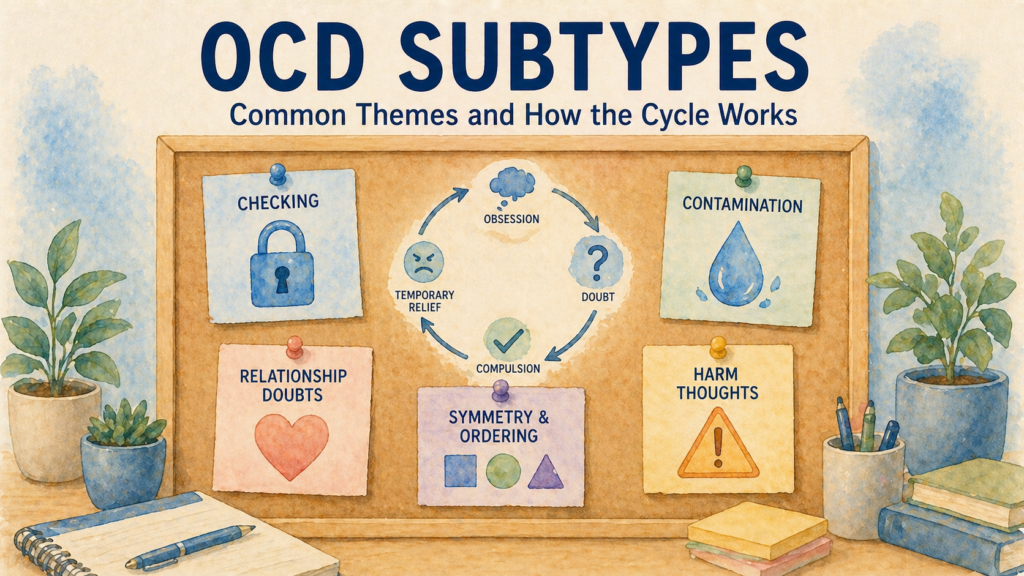
These themes can look very different on the surface. But underneath, the cycle is often similar: intrusive thought, anxiety, compulsion, temporary relief, and the doubt returning.
This article explains common OCD themes in plain language. It is educational and not a diagnosis. If symptoms are causing distress or interfering with life, consider speaking with a licensed mental health professional.
What are OCD subtypes?
OCD subtypes are informal labels used to describe the topic or theme of obsessive-compulsive symptoms. They can help people find language for their experience.
However, subtypes are not separate disorders. A person may have more than one theme, and themes can change over time.
The content may change, but the OCD process often stays the same.
| OCD process | What it means |
|---|---|
| Obsession | Unwanted thought, image, urge, doubt, or fear |
| Distress | Anxiety, guilt, disgust, shame, or urgency |
| Compulsion | Behavior or mental action used to reduce distress |
| Relief | Anxiety drops for a short time |
| Return | Doubt comes back and asks for another ritual |
Understanding the cycle helps people focus less on whether the theme is "real OCD" and more on whether the pattern is causing distress and repetitive rituals.
Common OCD subtypes and themes
| Theme | Common obsession | Common compulsion |
|---|---|---|
| Contamination OCD | "What if I get sick or spread germs?" | Washing, cleaning, avoiding |
| Checking OCD | "What if I left something unsafe?" | Rechecking locks, appliances, messages |
| Harm OCD | "What if I hurt someone?" | Avoidance, reassurance, mental review |
| Relationship OCD | "What if I do not really love my partner?" | Checking feelings, comparing, asking reassurance |
| Pure O / mental compulsions | "What if this thought means something about me?" | Rumination, reviewing, neutralizing |
| Scrupulosity | "What if I did something morally or religiously wrong?" | Confessing, praying, seeking certainty |
| Symmetry / just right OCD | "What if it feels wrong or incomplete?" | Arranging, repeating, evening up |
| Health anxiety overlap | "What if I have a serious illness?" | Checking symptoms, researching, reassurance |
This table is not a diagnostic tool. It is a way to understand patterns that people commonly describe.
Why the theme is not the whole story
OCD can attach itself to topics that matter deeply. A parent may fear harming a child because they value safety. A partner may fear being dishonest because they value love. A person with contamination fears may fear making someone sick because they value responsibility.
That is part of why OCD can feel so convincing. The theme often touches something meaningful.
But treatment usually focuses less on proving the thought wrong and more on changing the response to uncertainty, anxiety, and urges.
Can a person have more than one OCD subtype?
Yes. Many people experience multiple themes over time. Someone may have contamination fears in one season and relationship doubts in another. Another person may have checking rituals plus intrusive harm thoughts.
Themes can also overlap. For example:
- Contamination fears may include harm fears about making someone sick.
- Relationship OCD may include moral fears about being dishonest.
- Pure O may include harm, sexual, religious, or existential themes.
- Checking OCD may include responsibility fears.
This is why it is helpful to understand the OCD cycle rather than relying only on subtype labels.
Why subtype labels can help and hurt
Subtype labels can be useful because they help people find language. Someone who has never heard of relationship OCD or harm OCD may feel less alone when they realize other people describe similar patterns.
But subtype labels can also become a new source of checking. A person may search for hours trying to prove their theme "counts" as OCD. They may compare symptoms, read forums, or retake tests to feel certain.
It is usually more helpful to ask practical questions:
- Is this thought, doubt, image, or urge unwanted?
- Does it cause distress or urgency?
- Do I feel driven to do something to get relief?
- Does the relief fade and make me repeat the process?
- Is this pattern interfering with life?
These questions keep the focus on the cycle rather than the exact label.
What are mental compulsions?
Some compulsions are easy to see, such as washing or checking. Others happen inside the mind.
Mental compulsions may include:
- Rumination
- Replaying memories
- Testing feelings
- Silently repeating phrases
- Praying or confessing mentally
- Comparing thoughts
- Trying to replace a "bad" thought with a "good" thought
- Reviewing whether you are a good person
Because mental compulsions are invisible, people may think they have "just thoughts" and no compulsions. But if the mental action is repetitive and done to reduce distress or gain certainty, it may function like a compulsion.
How OCD subtypes are treated
OCD treatment often includes CBT with exposure and response prevention (ERP). ERP is adapted to the person’s theme, but the principle is similar: gradually face triggers while reducing compulsions.
| Theme | ERP may work on |
|---|---|
| Contamination | Reducing ritualized washing or avoidance |
| Checking | Leaving after one check and tolerating uncertainty |
| Harm thoughts | Reducing reassurance and avoidance |
| Relationship OCD | Reducing feeling-checking and comparison |
| Mental compulsions | Noticing rumination and returning to values-based action |
| Just right OCD | Practicing "good enough" and resisting repeating |
The OCD exercises page can help users practice daily skills, and the case studies hub offers research summaries related to OCD support.
FAQ
How many OCD subtypes are there?
There is no fixed number. Subtype labels describe common themes, not separate disorders. OCD can focus on almost any topic.
What is the most common type of OCD?
Common themes include contamination, checking, harm, symmetry, and intrusive taboo thoughts. The most important question is whether the pattern involves obsessions, compulsions, distress, and impairment.
Can OCD themes change?
Yes. OCD themes can change over time, especially when one theme no longer gets the same compulsive response.
Is Pure O a subtype of OCD?
Pure O is often used to describe OCD with mostly mental compulsions. The compulsions may be less visible, but they can still be very distressing.