
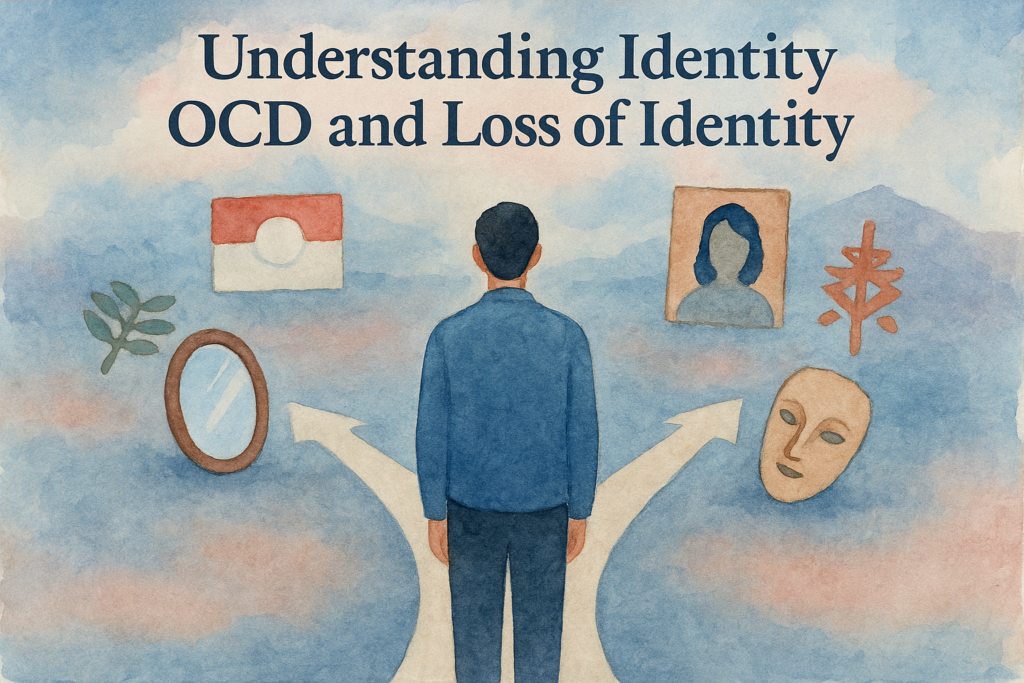
Identity OCD and feelings of loss of identity can significantly impact mental health. This article delves into these issues through a cognitive-behavioral therapy (CBT) framework, exploring how understanding maladaptive beliefs shapes our thoughts and feelings, ultimately guiding us towards greater resilience and emotional wellbeing.
The Nature of Identity OCD
Identity is a complex construct built on various factors, including personal experiences, beliefs, relationships, and cultural backgrounds. However, when individuals experience Identity OCD, this intricate framework can become distorted, often resulting in profound feelings of loss. Loss of identity can emerge from several life experiences, such as trauma, cultural dislocation, or personal crises. These feelings can become particularly pronounced for those grappling with Identity OCD, leading to a perpetual cycle of confusion and distress.
For many, trauma is a significant trigger for identity struggles. A person who endures a life-altering event, such as the sudden loss of a loved one, may find themselves questioning their identity. They might struggle with thoughts like, “Who am I without this person?” or “What is my purpose now?” These intrusive thoughts frequently feed into the compulsive behaviors characteristic of Identity OCD, further reinforcing maladaptive beliefs. For instance, an individual may respond to their anguish by obsessively seeking reassurance about their identity from friends and family, questioning their own memories and experiences connected to the person they lost. This behavior can create an illusion of safety, yet ultimately increases anxiety and isolation.
Another common source of identity confusion is cultural dislocation. Individuals who immigrate or experience shifts in cultural context may encounter feelings of alienation and disconnection from their former selves. For example, an immigrant who previously identified strongly with their cultural background may find that exposure to a new society leads to intruding doubts about their cultural identity. They may question whether they should abandon their previous values to fit in or honor their origins at the risk of social isolation. Those with Identity OCD may become entangled in obsessive thoughts regarding their cultural worth, leading them to compulsively engage in behaviors such as constantly comparing themselves with others or altering their cultural practices in a bid to conform.
Personal crises, such as unemployment or a divorce, can also lead to feelings of loss of identity. These events can trigger thoughts that lead individuals to feel unmoored and questioning. A person who has dedicated their life to a career may experience an identity crisis when faced with job loss, prompting thoughts like, “Without this job, who am I?” In individuals with Identity OCD, such thoughts can spiral into a cycle of obsessive rumination and compulsive acts, like continually revising their résumé or seeking validation from peers regarding their worth and capabilities. This cycle reinforces their sense of inadequacy, perpetuating a state of mental distress.
Consider the case of Hannah, a young woman who faced multiple identity-related challenges following her divorce. After years as a devoted spouse, Hannah began to feel a profound sense of loss about her identity outside of her marriage. Plagued by obsessive thoughts questioning her worthiness and desirability, she sought reassurance from friends but found the validation fleeting. Her compulsive need for external affirmation only served to deepen her feelings of inadequacy, making daily activities increasingly burdensome and anxiety-provoking.
These examples illustrate the intricate ways in which the feelings of loss tied to identity struggles can be aggravated by Identity OCD. The compulsive need to seek answers and reassurances can lead to an overwhelming dread that one’s identity is not only questioned but irrevocably altered. Understanding this interplay is crucial for both individuals suffering from Identity OCD and the mental health professionals supporting them. In doing so, we pave the path toward healing, enabling individuals to reestablish their sense of identity while navigating the complicated landscape of intrusive thoughts and compulsive behaviors.
Exploring Feelings of Loss of Identity
Loss of identity often emerges as a profound psychological experience characterized by confusion, uncertainty, and an overwhelming sense of disconnection from oneself. Such feelings can have various origins, including trauma, cultural dislocation, and personal crises, and they can significantly exacerbate the symptoms associated with Identity OCD. Understanding how these elements interplay is crucial for addressing the mental health challenges they pose.
For many individuals, trauma can serve as a catalyst for feelings of lost identity. A traumatic event, such as abuse, the sudden death of a loved one, or a serious accident, can shatter one’s sense of self. Coupled with Identity OCD, where intrusive thoughts about identity constantly disrupt an individual’s awareness of who they are, this trauma can create a chaotic internal landscape. For instance, consider the case of Jessica, a 28-year-old woman who experienced a severe car accident that left her physically and emotionally scarred. Following the incident, her Identity OCD intensified, leading her to obsessively question her worth, lifestyle choices, and even her relationships. This resulted in her feeling like a stranger in her own life, amplifying the trauma’s effects. Her obsessive thoughts convinced her that she no longer resembled the person she used to be, reinforcing her sense of disconnection and fostering negative thought patterns that spiraled deeper into despair.
Cultural dislocation presents another context in which feelings of loss of identity can arise. Individuals who migrate to new countries or cultures often face a myriad of challenges that can lead to alienation and confusion about one’s identity. This is particularly evident in first-generation immigrants who struggle to balance their heritage with the expectations of their new environment. For example, Ahmed, who moved from Syria to the United States, found himself caught between two vastly different cultures. His Identity OCD manifested as repetitive thoughts doubting his cultural authenticity, leading him to believe that he was losing touch with his roots. This inner conflict created a pervasive sense of uncertainty, as he grappled with maintaining his cultural identity while integrating into a new society. Ahmed’s negative beliefs about his identity, fueled by fear and obsessive thinking, reinforced feelings of inadequacy and an existential crisis regarding his place in the world.
Additionally, personal crises such as relationship breakdowns or unemployment can trigger identity disturbances. These experiences often lead individuals to reevaluate their self-worth and life choices. Sarah, a former executive who lost her job due to company downsizing, developed Identity OCD as she entered this uncertain period. The loss of her professional identity led her to question her abilities, her social roles, and ultimately her value in society. The negative thinking patterns manifested through rumination on failures and perceived inadequacies, which compounded her feelings of hopelessness and disconnection. Instead of seeing the job loss as a temporary setback, her Identity OCD led her to perceive it as a definitive mark on her identity, reinforcing the belief that she would never regain her sense of self.
These illustrative cases highlight the intricate relationship between trauma, cultural dislocation, personal crises, and Identity OCD. The ensuing feelings of loss can create a negative feedback loop where maladaptive beliefs are fostered, and mental health deteriorates. Individuals may find themselves trapped in cycles of self-doubt and uncertainty, handicapped by their identity struggles. Recognizing these patterns is essential for those who wish to reclaim a coherent sense of self and embark on a healing journey, one that can be further explored through cognitive-behavioral therapy and other supportive practices.
CBT: Transforming Thoughts and Emotions
Cognitive-Behavioral Therapy (CBT) is a powerful approach that enables individuals suffering from Identity OCD and feelings of loss of identity to reshape their thought patterns and emotional responses. At its core, CBT is structured around the understanding that thoughts, feelings, and behaviors are interconnected. By addressing the often distorted and unhelpful thoughts associated with Identity OCD, individuals can begin to uncover their true selves, rediscover meaning, and cultivate resilience in the face of emotional turmoil.
One of the foundational techniques in CBT is cognitive restructuring, which involves identifying and challenging irrational or negative thoughts that contribute to feelings of identity confusion and uncertainty. For example, a common thought among individuals with Identity OCD might be, “I am not the person I used to be; I will never find my identity again.” Such thoughts can exacerbate feelings of hopelessness and lead to a cycle of anxiety and self-doubt. Through the cognitive restructuring process, individuals learn to recognize these thoughts as mere interpretations rather than immutable truths. They can then reframe these thoughts, perhaps telling themselves, “I am in a state of change, and that is a part of life. I can explore new aspects of myself and grow.”
Another critical aspect of CBT is exposure therapy, which can be particularly beneficial for those struggling with Identity OCD. Exposure therapy entails gradually confronting feared situations or thoughts in a controlled manner. For instance, someone with Identity OCD may fear engaging in social situations because of the anxiety surrounding their sense of self. By beginning with less intimidating social interactions and gradually progressing to more challenging scenarios, individuals can lessen their fear response and ultimately build confidence in their identity and social skills. This process allows for emotional flexibility, enabling individuals to navigate their feelings surrounding their identity without being overwhelmed by anxiety.
Incorporating behavioral experiments can also serve as an effective strategy within CBT. Such experiments involve testing the beliefs held about oneself against real-life experiences. For instance, a person might believe, “If I explore new interests, I will lose the parts of my identity that I cherish.” An effective behavioral experiment would encourage them to engage in a new hobby or activity they have always wanted to try, providing a safe space to challenge this belief. By documenting their experiences and feelings throughout the process, individuals often discover that exploring new aspects does not diminish their core identity but instead enriches it.
Mindfulness practices integrated into CBT can further enhance emotional regulation. Mindfulness exercises encourage individuals to become aware of their thoughts and feelings in the present moment without judgment. This awareness can be particularly empowering for those grappling with Identity OCD. Rather than becoming entangled in overwhelming thoughts about identity, practicing mindfulness allows individuals to observe their thoughts as passing phenomena. This shift promotes greater emotional resilience, reducing the grip of anxiety provoked by identity concerns.
There are countless real-life success stories where individuals have harnessed CBT to navigate their struggles with Identity OCD and the accompanying feelings of loss of identity. One such story is of Sarah, who, after experiencing a traumatic event, fell into the debilitating trap of questioning her identity. Through regular sessions focusing on cognitive restructuring and exposure therapy, Sarah progressively challenged her intrusive thoughts, leading to a renewal in her sense of self. She learned to embrace uncertainty as a part of her journey, fostering a newfound sense of purpose and connection to her authentic self.
By employing CBT, individuals are equipped not only with the tools to confront their fears and distorted thoughts but also with the resilience necessary for long-term mental well-being. As they journey through understanding and reframing their identity, they emerge stronger and more attuned to their true selves, capable of navigating the complexities of life with greater confidence.
Conclusions
In conclusion, understanding and addressing Identity OCD and feelings of loss of identity through cognitive-behavioral therapy provides a pathway to improved mental health. By challenging maladaptive beliefs and fostering healthier thinking patterns, individuals can enhance their resilience and reclaim their sense of self, ultimately leading to a more fulfilling life.